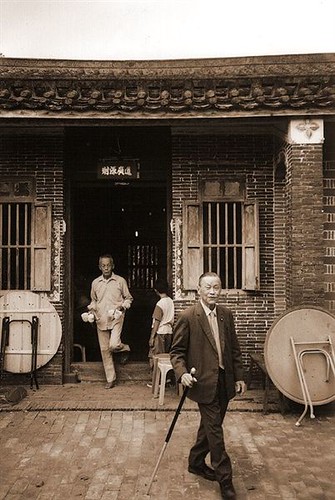
Uncle Y Y Lee outside the house he was born in

A couple of things precipitated this blog post. First, I found a link from this Hainan Island related site.

Then I remembered that my uncle (father’s brother) didn’t attend my wedding because, as my cousin informed me a day before that, that he ‘couldn’t make it, because his leg cannot lah’, and how I thought it would have been nice for him and my dad to meet up, given that both of them are coming along in age, though at this time, I don’t want to say either of them is ‘ailing’.

I was a bit disappointed because I had even gotten Naomi to practice saying ‘Uncle, drink tea’ in Hainanese, after asking my father how to say ‘Uncle, drink tea’ in Hainanese.

It’s been a while since Part Three, and even longer since I was actually on the trip to the island of my forefathers.

Read Parts One, Two, Three.

The tour bus took us to Kachek town, and dropped us off at a 3-star hotel (so my cousin told me), but by this time, whatever stars that rated hotels on Hainan meant little as we checked ourselves into our rooms with the rock hard coconut husk beds.

After resting a bit in our rooms, my cousin made another phone call to the ancestral village to inform whatever relatives we had there that we had arrived. We were then told that ‘a few of them would be coming down to have coffee with us’.

I had never spoken to any of these relatives, much less known what they looked like, though I’ve been told that all Hainanese men look alike, and that every waiter at Shashlik looked like Dad, and Mum had previously told me that all Hainanese women looked like my grandmother. At 80.

But none of us expected a welcoming committee from the village, on a rickety hired bus, driving into the hotel’s car park and disembarking into the lobby, to ‘have coffee with us’. I think there were at least a dozen of them. At least they didn’t bring any coconut-related souvenirs, because by that time I had sworn off coconuts for life. It’s a bit hard to explain how pervasive the coconut problem is, but you’d get an indication reading the tourist information for the City of Wenchang, which begins like this:

Distinguished by the quality and quantity of its assorted coconut products, Wenchang City is a vital gateway to a lively area that contains some of Hainan Province’s most charming sightseeing and holiday destinations…

Coffee at the hotel’s lobby cafe, which also served all manner of coconut drinks, took a good two hours, with long conversations, mostly with the Hainanophone among us jabbering away, and with me nodding and smiling. My cousin later told me that my relatives were telling us about the sad state of my great grandfather’s grave, which, due to lack of maintenance, due to a lack of funds coming from the Lee family overseas, had been overrun by chickens from the free range chicken farm nearby.

The next morning, the rickety bus came to the hotel to fetch us to the village, this time, only six relatives served as entourage, and about an hour into the journey, we arrived at a dusty, non-descript township, where, upon the gutteral utterances of the driver (who was a cousin as well, I discovered) we disembarked and were led into a shophouse, where we were made to buy incense, hell-money and enough firecrackers to burn down a small town.
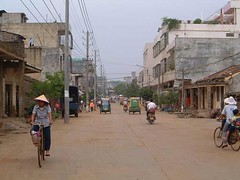
Dusty township, Hainan
The township looked something like this: Dusty and unremarkable

Then bus driver-cousin said something, and my travelling-companion-cousin handed more cash over to him, and off we went to another shophouse, where more things were bought. All this while, of course, we had to keep my uncle from buying more coconut-related souvenirs.

Another half hour on the bus and on a dirt road where we passed several tiny villages with really old-looking buildings, we disembarked outside a little drinks kiosk-like building that had benches and a shelf that looked like it would have housed a television set. Bus driver-cousin and entourage-cousins beckoned for us to follow them behind the building, on a tiny footpath lined by trees. A five-minute trek later, we were in what looked like a little nook in the woods, with a cluster of buildings that made the place look like the set of ‘Crouching Tiger, Hidden Dragon’. It was that old.

We walked past a well with an electric motor pump, which my cousin said was the ‘running water’ that my Dad and uncle had donated money to the village for, and then we were guided through a courtyard and into a small house. On the wall were photographs of people who looked really familiar – and then I realised they were of my uncle and of Dad, taken some time in the 60s. Alongside those photos were those presumably of other uncles and cousins, though, like I’ve been told, you can’t really tell because all Hainanese men look the same.
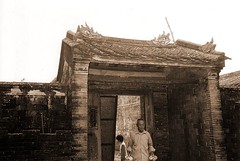
Entrance to our ancestral home
A very distant cousin brings coffee mugs out of the house

A few chairs lined the walls, and we were asked to sit and wait as scores of people started streaming into the house, and according to my cousin, all of whom claimed to be a cousin or other. This was supposed to make us give them ang pow money or something. Some came, said a few words, took their share, and left, while others would come in, jabber away for a longer time, leave, and then come back again to say some more.
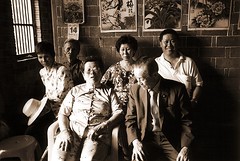
hainan10
Uncles, aunts and cousins cram for a photo

Then a line of men came into the house, and I was told they were the village school’s teaching staff. Remembering that my Dad told me he donated money to build the village school, I asked to be taken to the school for a look. It was a pretty rundown two-storeyed building, and empty. Then one of the teachers showed me a few Peruvian nuevos soles from his wallet, and asked in Mandarin if they were American dollars. ‘South American’, I said, in Mandarin. He then insisted they were American dollars, because, he said, someone had exchanged them for a substantial amount of Renminbi with him.
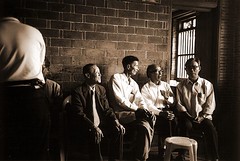
hainan09
Uncle Y.Y. with the visiting schoolteachers

Then came time to visit great grandfather’s chicken overrun grave. Bus driver-cousin led the way via a series of footpaths, holding the long coil of firecrackers we had let him buy earlier. There was a small headstone which he dusted off, and we could make out our surname on it, and not much else. Not that it would’ve mattered, since neither of my travelling-companion cousins could read Chinese.

The thing about Great Granddad’s grave was that it was situated in sort of an open ground, sort of in between villages. It wasn’t in a cemetery proper, which probably explained the chickens running amok and flattening, over the years, the mound that distinguished a grave as a Chinese one.

The chickens were there when we got to the grave, but no matter, Great-Granddad was treated to the longest firecracker barrage I’d ever heard, and we returned to the house as soon as the smoke cleared, which was after we had stamped out the little brushfires that the firecrackers and burning hell notes started, but I think we were slightly pleased that the rogue chickens were probably scared shitless and deaf by now.

But one of my cousins was quite visibly disturbed, and she paused to ask why Great-Granddad was buried so near the house, to which I offered, ‘because last time no ambulance, people die already got no car to take them to the cemetery’. She seemed pretty satisfied with that explanation, which was good, because I was being eaten alive by mosquitoes at that point, and wanted to get out of the bush as soon as possible.

Back at the house, a feast was being prepared for the visiting Lees. This meant half the duck population in the village squawked their last as they were turned into the county’s specialty – boiled/steamed duck. The courtyard outside the house was set up with tables and stools, as we were taken indoors and shown the room which Uncle Y.Y. and my Dad were born in.

I was told how both Uncle and Dad had left Hainan at a very early age to look for Granddad in Malaya, leaving Grandma behind until she managed to find her way to Malaya via Vietnam, Cambodia and Thailand.

There were stories of other cousins and uncles who left the island from the 1930s onwards, in a two-generation long diaspora that waned only recently, and probably ended with the reverse migration of several old Hainanese back to the village from Malaysia and Indonesia.

But food was served, steaming duck with the county’s other specialty – a yellowish chili sauce that was spicier than it looked. The feast was surprisingly good, although I remained a little unnerved by the number of villagers who stared and kept commenting how much I looked like Granddad and Dad.

After the meal, my cousin requested that we be brought back to Kachek town as it was getting late and that we didn’t want to keep them from doing their thing, seeing as it was a weekday and all. Of course, the villagers didn’t do much besides tending to the ducks and vegetables, whether it was a weekday or not, because most of the able-bodied members of the Lee clan had long since gone to the cities for work, leaving only the old and very young crouching and hiding about the village buildings.

Truth was, we were looking for clean toilets, and the amenities in the village would have been less than able to withstand the work of my weak stomach.

After we were dropped off back at the hotel, and goodbyes said (including a false promise of a return to the village the next day), we flagged a taxi and asked the driver to take us downtown, the Singapore-Malaysian-Hainanese word for which was different from the Hainanese-Hainanese word.

At the chicken slaughterhouse a few minutes outside downtown Kachek, the taxi-driver laughed his Hainanese head off when we explained that our word for ‘downtown’ sounded exactly like his word for ‘chicken farm’, and that we really didn’t want to have dinner there.

Having made his day, the taxi-driver very kindly took us downtown, to a street with many outdoor food stalls, where we had a dinner of fried noodles before my female cousin said she was going to look for a dessert that our late Grandma used to tell her about. Something called ‘Guay Dai Din’ in Hainanese, which translates to ”Chicken Shit’ Something’ in English.

She found it, this Chicken Shit Something, and ordered a large basin of sweet syrup filled with black starch pellets, to share with all of us. It wasn’t half bad, this dessert, and I think it would’ve made it to Southeast Asian Hainanese kitchens and restaurants if it wasn’t saddled with such a marketing problem.

The next day, the tour van came back and picked us up for the long drive back south to Sanya, where we were treated to more coconut-related tourist spots before finally boarding the charter back to Kuala Lumpur, with a hundred odd Hainanese pilgrims carrying a load of coconut by-products and many, many stories of the home country.

Technorati Tags: ,

Comments

  • Marina Burn
    Hello Steve Lim.
    Overseas Hainanese are allow to file for return of all Land and properties conficasted by the government. You have to go thro your local Hainanese asssociation where ever you are and make inroad connection to the local county in Hainan for the claim.

    Marina Burn
  • That's interesting Marina. Would be amazing if it were possible.
  • STEVEN LIm
    YOU are lucky.. THe old house is still in usable condition.

    My dad's house is partly ruin. One third damaged to the ground since Japanese invasion 70yrs ago. The other 60%, intact except for the roof. The paddy lands confiscated by communists lords. The vacant lands grab by neighbours and relatives with better contacts with dept concened. Grandpa murdered during Gang of Four revolution and grand ma survived almost alone. All assets grab by all concerned.

    We visited 2-3 times.

    Previously, we were told to rebuild the house. Now, we were told no need to. I am suspicious that they want to grab the house too.

    Do they have land title office there to confirm ownership?

    Is it costly to rebuild a house?
  • this is a really interesting trip. I have enjoyed reading and I'm planning a similar trip next year.
  • Good for you Marina. I didn't get the organised mayoral welcome nor the military escort. I must have had the wrong travel agency :).
  • Marina Burn
    Hello Miyagi,
    You downplay hainan as an underdevelop pieces of shit and it is not fair. I have been to Hainan in 2003, 2005, 2007. We were welcome with biggest hearts that is the hainese in hainan that I have never seen in my life. Children lining up in the sun rows over rows miles upon miles to welcome us. Where every we go there is always a military personal with us. Everywhere we go the Hainanese delegate from Hainan is there to received us. Even when my Uncle and I went to Wenchen at the ancestrial village the Major of Wenchen excorted us there. Hainan is very beautiful even words could not describe it . Especially at Sanya while soaking oneself in the hotsprings one could image as a fairy desending from heaven enjoying the comfort. I will be going back to Hainan again in November 2009. I have travel everywher in the world it is Hainan that I always to back to.
    See you again in Hainan
    Marina Burn
  • ka koi
    hi...

    my name moko...jia qi(chinese)...but dunno in hainanese hehe
    i can't speak hainam, may just few words...but my father knows hainanese lil' coz my grandpa died when my father was child..
    any one know how i can learn hainam?? or hainam dictionary??
    boh kai..

    i don know why but i wanna find out bout hainam this lately..bout people, may how they live there?? it's like that you can give me a real atmosphere in hainam hei...(may it's the only me, coz i like a photograph)

    i donno my granpa also has a related of communist & Koumingtang, so he has been chased in hainam before(he told that to my father before he died)...and that's a really2 tough time that time..

    for mr.miyagi, i really love your posting about hainam, coz i never visit there...:(

    hehe...keep posting bro...thank you very much :)
  • gf
    Btw, I was taught that drink tea is " cheak deh"...
  • gf
    Hi, just got back from Hainan 3 days ago, went to my grandparents home town at Xionghai, kaichek, Gu kwou Sui, surname Lee. Just need some info. as to why many of those left QiongHai in haste, with stories of fights/killing & most of the older folks have fears of returning to their villages. Are the fight among communist & Koumingtang? I cldn't understand what my late granny said when she refers those period as difficult time...Anyone know?
  • Hey thanks for the comment on my blog at: http://blogist.wordpress.com/2008/04/03/lands-e...

    I added more photos to illustrate how the "Kwei Tai Din" and "Kwei Tai Bwa" comes from.

    Btw, I'm 18 this year and went back to Kachek alone just a week ago. hehe. My grandpa's village is at Qionghai, Wenquan. Jinpo Village.
  • bo soon
    Just return from Hainan today from Wechang, Sia Liang Chun (ancestral home), stayed there for 1 week and slept in the room that my grandparents lived and saw my 1st ancestral tomb just outside the house.
  • James99
    hi guys, where can i find hainanese restaurant in Singapore?
  • NickCheong
    99.9 percent Hainanese are sohai's , Nang bo dee Nang, Gui bo dee gui
  • Simon
    Hi Ah Kor,

    Just came back from the beautiful island of Hainan, to look for my roots in the province of Qionghai, where Kaichek is the main city. Food and lodging were cheap compared to Singapore. Had a breakfast meal of 6RMB (about S$1.50), and lunch at a restaurant is about 100RMB (S$20) for four pax.
    And if you want hotel lodging lobangs in Kaichek or Haikou, and lessons in Hainanese, please look for me (suankhim@hotmail.com), can introduce you to some of the hotels (cheap and good, and most of all centrally located). In addition, I travelled via Kaicheck / Haikou to/fro via the public express bus (25RMB). Been touring the island with tour groups twice since 2006, and I am most impressed with the Nan Hai Kuan Yin (also known as Nan Shan). The image is simply beautiful, and the scenery is most impressive, it is most serene just looking at the image and the sea.
  • amax
    you take a lot of nice picture i like it alot...recently i am going to open a hailam cafe in kl can i use some of the pic you have shoot
  • Shooting chickens? Why on earth would you need to shoot chickens? Oh wait. Yah, Hainanese.
  • Jay
    Im hainanese too! Unfortunately, i can only say 'jiat buay'... Im so embarrassed about not being able to speak my dialect and the loss for words when communicating with my only grandmother. Im looking for hainanese lessons.. so if anyone out there have any lobangs, please contact me! @ jay_wmd88@hotmail.com OH ya, nice pics, brought me back to 10 years back when i was visiting my grandpaps in his village. Dang it was fun, with the shooting of chickens and etc.
  • Bernice Lee
    I went to Hainan in March'07. The places I've visited are Haikou, Sanya, Wenchang, Qiong Hai and WanNing. The beaches in Sanya are really nice, with fine sand and water crystal clear. Shopping open till 11pm. Food and fruits are really cheap. For my friends who are non-Hainanese, they had no communication problem because Mandarin is a common spoken language in the island. Definitely, I'll visit the place again.
  • Hi Chiau, No I don't think Wenchang's too touristy, though places like Sanya might be. Local transport is um... patchy at best. Best to get a tour package and pay the driver extra to point you to places. Then again, that was 2002, and things might be a bit different now.
  • chiau
    Hi
    I read your site cos my mum pass on last year and I thought I'd go visit the place she was born in Wenchang and maybe write a book in the future - a record for her grandchildren. I was wondering if it is too touristy? Im a seasoned backpacker and would like to make the trip this october. Do u think the local transport is efficient?
    You blog was a good read. Tks.
    Cheers
  • Chee Min
    I visited my ancestral home some twenty years ago. We tour the island while the red guard was creating turmoil in Bejing. It was at the peak of the so call cultural revolution. The local TV did not reveal much. I managed to follow the event on BBC short wave. My ancestral village is linked to Kachek City, Is called "Shum Tua" farm head.
  • Miss Tan
    My dad is Hainanese, but has never spoken the dialect with me. My grandpa died before I was born, and I never got to converse with my granny whom I saw once a year and who has also passed away. It's all very sad. Apart from knowing my roots are in Hainan Island, I don't know anything else. No ancestral village, no relatives, nothing. It's quite depressing not knowing where you came from.
  • tom mckay
    Thanks alot for the info. I will move to Haikou soon, guess its true about there being so many hainan expats.

    regards
    tommckay1478@hotmail.com
  • JH
    Your trip sounded exactly like my family's whenever we return to Hainan (I am 3/4 hainanese (boon-sioh x2, ka-chiek x1), 1/4 hokkien but very proud of my hainanese roots). Just thought I'd mention something - My granduncle who lives in Malacca rang us excitedly one evening to tell us that the current PM of M'sia (Abdullah Ahmad Badawi) is half hainanese-chinese.
  • Thanks for reading! Your trip sounds really enjoyable too.
  • Chong
    Dear Ah Kor

    I too went back to Hainan island for the first time in November last year and my home village was near Hai Kou in Wenchang area in a district called Foal Tai. Reading your blog brings back memories of the vist with my father. I brought my kid along as well and I actually spent a night in the ancestral home and enjoyed speaking to my cousins and uncles in hainanese that I learnt from my parents and grandparents.

    We also took in a tour of the whole island and visited places that you did including the Botanic gardens, hot springs, Southern mountain with a 1500 year old Buddhist temple and 5000 grave mounds sprinkled on the mountain, ate the Wenchang chicken and the Kachek duck, visited Charlie Soong's ancestral home....yes the father of the famed Soong sisters was hainanese.

    Also saw Hai Rui's tomb that was vandalised during the Cultural Revolution because the event that triggered the Cultural Revolution was a play about Hai Rui. Apparently the play was about Hai Rui (loyal prime minister and his despot tyrant of an emperor) and his emperor ...the play was seen as an oblique reference to Mao Tse Tung.
    Enjoyed your Hai Nan trip blog very much. Cheers
  • Lynn Seah
    I married to a hainanese men. A very good husband. We plan to visit our in-laws hometown (Wenchang - Mai Hao) this coming school holiday. Been looking for more informations about Hainai Wenchang esp the small town.

    Your blog is unique and I also love the black and white pictures.
  • WOW!What a great read.

    My grandparents practically raised me and my bro and I swear we spoke Hainanese like pros... whonder what happened.

    Went to look for my roots on Hainan Island too when I was a kid. The most vivid memory I have of that: stepping on a praying mantis while half asleep. Yup, I just goofed it up.

    Love your pictures!
  • Chris
    I'm hainanese too. A pleasant surprise that one of the frequent bloggers that I'm reading about is Hainanese too.
  • Jo
    hey, how interesting. My grandparents came from some village in Wenchang, Hainan too (perhaps our grandparents know each other; you'd never know ;p). I went to Wenchang (Hainan) with my family 5 years ago and my dad was looking for a relative with the surname Fu. Imagine his surprise when he's told that almost everyone has that surname in that particular village. :) [since then our family has visited our relatives a few times].
    I happened to be able to speak Hainanese so it's really delightful that they understand what I said to them :)

    I agree with BondX that ’sweh dae-er’ is 'drink tea' in Hainanese.
  • A little something from me for the enjoyment of everyone, especially fellow Hainanese:

    http://hutdugaikarsui.blogspot.com/2006/03/comi...

    http://hutdugaikarsui.blogspot.com/2006/09/just...

    :D
  • papercloud
    great post, loved the pictures and i was chuckling at the pc in the office reading it! :)
  • BondX
    Im Hainanese too.

    Tea shd be more like 'dae-er'
    I m not sure abt 'jia' - literally, eat tea ... shd be more like 'sweh dae-er'

    Heh heh, I thot Hainan Island is where if the Emperor dun like u, u get banished there. [LOL]
  • Gorgeous pictures. Were they taken by you?
  • I will find some 'chicken shit something' at lunch one of these days. BTW, my family's not from Wenchang City, they're from near Kachek, which is in Henghai (Qionghai) County. In the northeast. Or so they tell me.
  • hao
    ah kor..

    the 'chicken shit something', can be found in certain hainan eating places in singapore. i think somewhere on the east side.

    my parents claim it prevents cancer. they eat it almost everyday. can't remember where my mum gets the veggie from. apparently plucked from somewhere. she swears it's the real thing.

    my grandfather was from Wenchang too, my ancestral village is baofang village.

    and yes, most hainan island men do really look alike. it's still very much the wild wild west of the china, or south rather, as you have captured with your pic of the township. pretty much left behind while the rest of coastal china speeds along in progress and consumerism.

    apparently one of my ancestors was some military officer who fought in some war..which kinda explains my snarling satisfaction at the sound of 'first blood!'.. o_O
  • bloom
    It's actually deh3 (think hanyu pin yin). Being brought up by my only-can-speak-hainanese-grandparents, I'm pretty proud to say I can converse with my grandfolks' generation without a hitch.
  • hy
    i'm hainanese too. really enjoy reading all your posts on the heritage.
  • jerzak
    I am half-Hainanese. Drink tea is "Jia leyh."

    "Jia leyh coo baw?"
  • Mag
    I really like the pics!
    *clap clap*
  • Weimin
    Omg, the mother never told me those stories. Love the pics, really special.
  • tea in hainanses is 'teh' but it sounds different from the hokkien 'teh'. instead of going up, the tone towards the end goes down. hope i'm making sense heh

    nice reading your post miyagi... reminds me of the time when i went back alone to my grandfather's village. he was from wenchang too
  • Really enjoyed reading this Mr M.
  • ledmirage
    i can only speak hainanese when i was 3 years old :p
    i was born there.
    but after i moved to HK, 3 months later i could only speak cantonese ...
  • Ah Hainan, land of crazy people.
  • Marina Burn
    Hello Shaolin Tiger,
    This is a racial slunr. Please check us up with the world famous chinese, the answer speaks for it self.
    Marina Burn
  • samantha
    lol. yeah. not many people knows how to speak hainanese. especially youngsters. i think in future it might even extinct. i, myself is also one, who rarely speaks it. the problem often faced is we know what they are talking but dont know how to respond.
  • daphne
    in hainanese, uncle, drink tea is... 'boh deh, jia ___' i dont know how to say tea in hainanese.. anyway im hainanese too and been trying to speak more hainanese.... not many people know how to speak!
blog comments powered by Disqus

  • Twitter

  • Polls

    Who will win the World Cup?

    • Brazil (18%, 30 Votes)
    • Spain (18%, 30 Votes)
    • Argentina (9%, 15 Votes)
    • Germany (7%, 12 Votes)
    • Netherlands (7%, 12 Votes)
    • Italy (7%, 11 Votes)
    • England (6%, 10 Votes)
    • North Korea (5%, 9 Votes)
    • France (3%, 5 Votes)
    • Japan (3%, 5 Votes)
    • Cote d'Ivoire (3%, 5 Votes)
    • South Korea (2%, 4 Votes)
    • Portugal (2%, 4 Votes)
    • Australia (2%, 4 Votes)
    • South Africa (1%, 2 Votes)
    • Nigeria (1%, 1 Votes)
    • Algeria (1%, 1 Votes)
    • USA (1%, 1 Votes)
    • Cameroon (1%, 1 Votes)
    • Slovenia (1%, 1 Votes)
    • Greece (1%, 1 Votes)
    • Serbia (1%, 1 Votes)
    • Mexico (1%, 1 Votes)
    • New Zealand (1%, 1 Votes)
    • Switzerland (0%, 0 Votes)
    • Slovakia (0%, 0 Votes)
    • Paraguay (0%, 0 Votes)
    • Honduras (0%, 0 Votes)
    • Ghana (0%, 0 Votes)
    • Denmark (0%, 0 Votes)
    • Chile (0%, 0 Votes)
    • Uruguay (-2%, 0 Votes)

    Total Voters: 167

    Loading ... Loading ...
  • Archives

  • Ads


Switch to our mobile site